

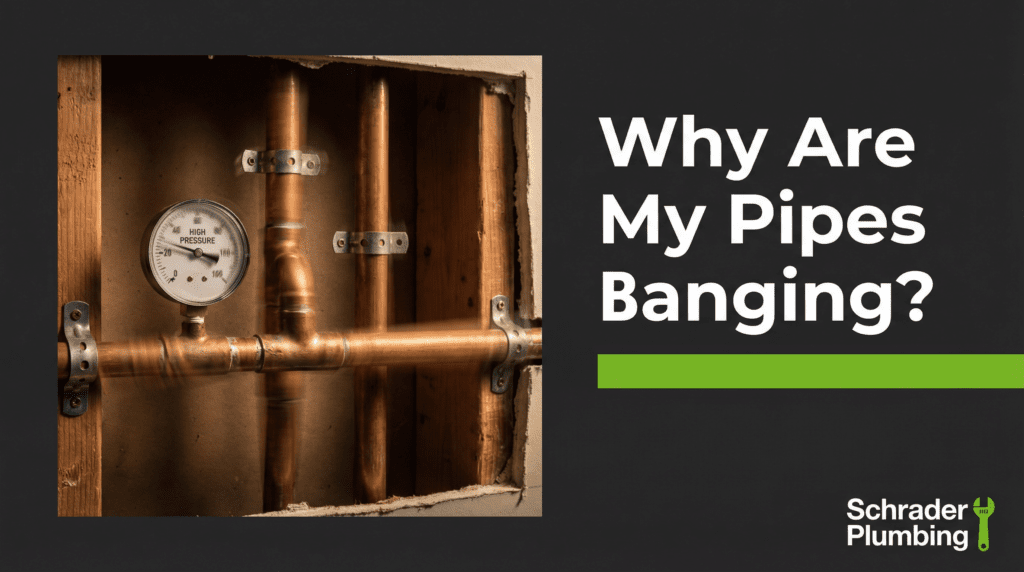
Why are my Pipes Banging?
It usually happens when the house is quiet. You turn off the kitchen faucet, or the washing machine finishes its cycle, and suddenly you hear it — a loud, startling bang echoing from inside your walls.
Banging, knocking, or clanging pipes are more than just a nuisance. They are your plumbing system’s way of signaling that something is wrong. While a single knock might not seem like an emergency, repeated banging can eventually damage pipe joints, wear out appliance valves, and even lead to hidden leaks.
At Schrader Plumbing, we have spent over 20 years diagnosing and silencing noisy plumbing systems across the DFW Metroplex. In this guide, we will break down the most common reasons your pipes are banging and explain what can be done to restore peace and quiet to your home.
1. Water Hammer (Hydraulic Shock)
The most frequent culprit behind banging pipes is a phenomenon known as water hammer (technically called hydraulic shock).
When water is flowing rapidly through your pipes and a valve is suddenly shut off, the water has nowhere to go. Because water cannot be compressed, its forward momentum slams into the closed valve, sending a powerful shockwave back through the plumbing system . This shockwave causes the pipes to vibrate violently and bang against the surrounding wood framing.
Water hammer is most commonly triggered by modern appliances with fast-closing solenoid valves, such as:
•Washing machines
•Dishwashers
•Ice makers
The Solution:
Historically, plumbers installed vertical “air chambers” in the plumbing lines to absorb this shock. However, these chambers frequently become waterlogged and stop working. The modern, permanent solution is to have a licensed plumber install water hammer arrestors. These small devices contain a pressurized air chamber and a rubber piston that absorbs the shockwave, protecting your pipes and appliances .
2. High Water Pressure
If your pipes bang when you turn the water on rather than off, or if you hear a continuous rattling while water is running, you may be dealing with high water pressure.
Residential plumbing systems are designed to operate safely between 40 and 60 PSI (pounds per square inch). If the water pressure entering your home exceeds 80 PSI, the sheer force of the water can cause the pipes to vibrate and knock against the walls .
Beyond the annoying noise, excessively high water pressure is incredibly hard on your plumbing. It can dramatically shorten the lifespan of your water heater, cause your toilets to run constantly, and lead to premature failure of your appliance hoses.
The Solution:
A professional plumber can test your home’s water pressure using a simple gauge. If the pressure is too high, the fix is to install or replace a Pressure Reducing Valve (PRV) on your main water line. This valve regulates the incoming municipal water pressure down to a safe, quiet level .
3. Loose or Poorly Secured Pipes
Sometimes, the cause of banging pipes is purely structural. Water is heavy, and as it rushes through your plumbing, it creates natural vibrations. If your pipes are not properly secured to the wooden studs or floor joists inside your walls, those vibrations will cause the pipes to physically strike the framing.
This issue is especially common in older homes, or in houses where partial plumbing renovations have been done without adequate support. Copper pipes tend to be noisier than plastic (PEX or PVC) when they are loose .
The Solution:
If the loose pipes are accessible — such as in an unfinished basement, crawlspace, or utility room — the fix is relatively straightforward. The pipes need to be secured using properly sized pipe straps or U-clips. Industry best practices dictate that pipes should be supported at least every few feet and at every change in direction. For pipes hidden behind drywall, a professional plumber can help locate the exact source of the noise with minimal disruption .
4. Thermal Expansion (The “Ticking” Sound)
If the noise you hear sounds more like a rhythmic ticking, creaking, or popping — and it only happens when you use hot water — the culprit is thermal expansion.
When hot water flows through cold metal pipes (particularly copper), the sudden temperature change causes the metal to expand slightly. As the pipe expands, it rubs against the wooden studs or tight drilled holes it passes through, creating a ticking noise. Once the water is turned off and the pipe cools down, it contracts, often repeating the sound .
The Solution:
While thermal expansion noises are generally harmless, they can be highly irritating. If the pipes are accessible, wrapping them in foam insulation or inserting plastic spacers between the pipe and the wood can eliminate the friction and silence the ticking .
5. Air Trapped in the Lines
If you have recently had plumbing work done, or if the municipal water supply was temporarily shut off, air may have become trapped in your plumbing lines.
When you turn on a faucet, the trapped air pockets are forced through the pipes alongside the water, causing a sputtering, rattling, or banging sound as the air tries to escape.
The Solution:
Fortunately, this is often a DIY-friendly fix. You can purge the air from your system by turning off your main water valve, opening every faucet in the house (starting from the top floor and working your way down), and flushing all the toilets. Once the system is completely drained, slowly turn the main water valve back on. Let the water run until the sputtering stops and the flow is steady, then turn off the faucets one by one .
Quick Reference: Diagnosing Pipe Noises
| What Does It Sound Like? | When Does It Happen? | Most Likely Cause |
| Loud bang or thud | Immediately after a valve or appliance shuts off | Water Hammer |
| Continuous rattling | While the water is running | High Water Pressure or Loose Pipes |
| Rhythmic ticking/popping | While using hot water, or shortly after | Thermal Expansion |
| Sputtering and banging | When you first turn the water on | Air in the Lines |
When to Call Schrader Plumbing
While purging air from your lines is a simple weekend task, dealing with high water pressure or installing water hammer arrestors requires professional expertise. Ignoring banging pipes can eventually lead to weakened joints, burst pipes, and severe water damage.
At Schrader Plumbing, we believe in doing the job right the first time. As a family-owned business serving North Richland Hills, Fort Worth, and the surrounding DFW area, we charge by the job, not by the hour. When you call us, you will get an honest assessment and a clear, upfront price before any work begins.
If your home’s plumbing is making a racket, don’t wait for a small annoyance to turn into a major repair.
Call Schrader Plumbing today at (817) 262-0989 or visit schraderplumbing.com to schedule an inspection.
Categories: Water Lines,By: Michelle Kurcina
Last modified:
Last Modified: August 4, 2026 at 6:51 pm
