

Conventional Water Heaters vs. Tankless Water Heaters: How to Know If It’s Malfunctioning
Hot water is something most of us take for granted — until it disappears. Whether you are stepping into the shower on a cold Texas morning or running the dishwasher after dinner, your water heater is working quietly in the background to make daily life comfortable. But when it starts to fail, the signs can range from mildly annoying to genuinely costly.
At Schrader Plumbing, we have been helping homeowners across the DFW Metroplex make smart, informed decisions about their water heaters for over 20 years. In this guide, we will break down the key differences between conventional storage-tank water heaters and modern tankless systems, and walk you through the most important warning signs that your water heater may be malfunctioning — before it becomes a full-blown emergency.
What Is a Conventional Storage-Tank Water Heater?
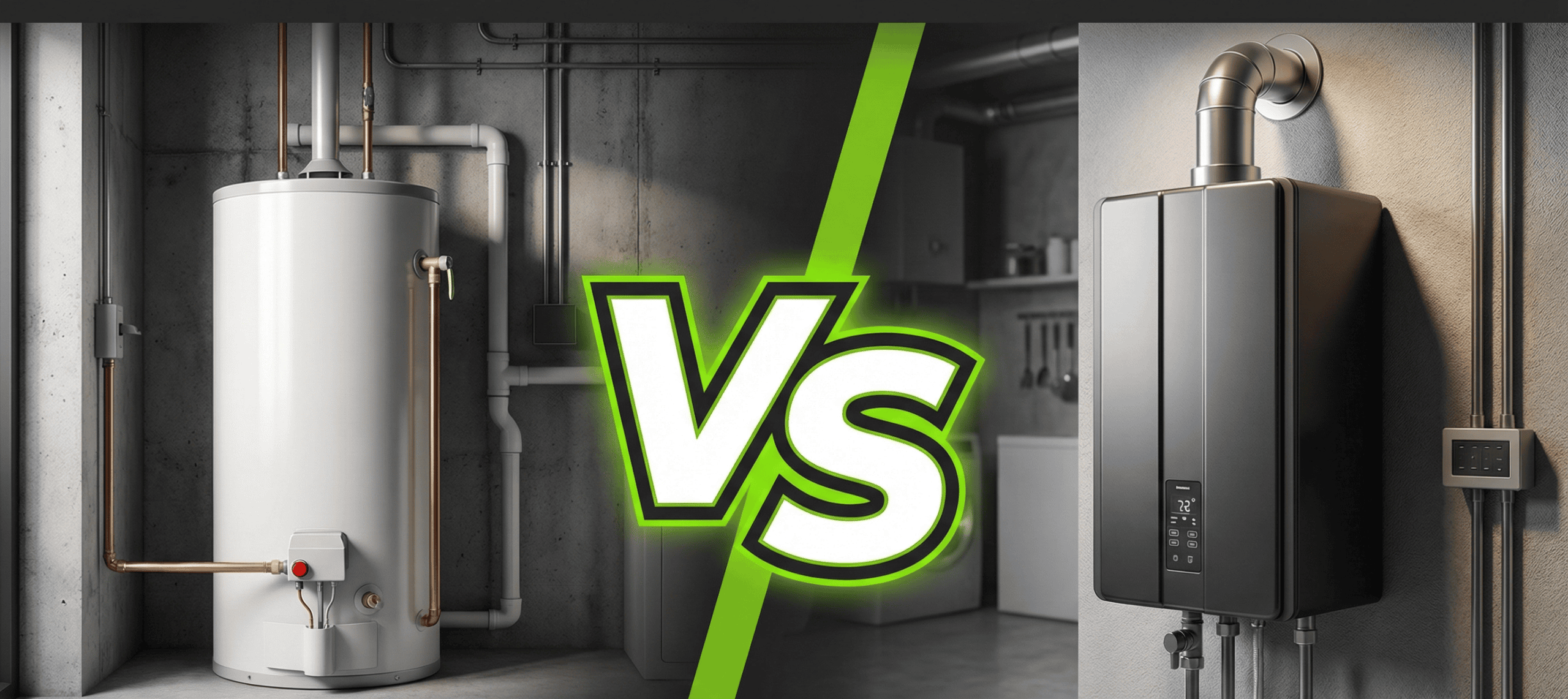
A conventional water heater is the large, cylindrical tank you have probably seen in a garage, utility closet, or basement. It works by continuously storing and heating a set volume of water — typically between 30 and 80 gallons — so that hot water is ready the moment you turn on a faucet.
These systems are powered by either natural gas or electricity, and they have been the standard in American homes for decades. Their widespread availability makes them easy to replace, and their lower upfront cost makes them attractive for budget-conscious homeowners. For households with predictable hot water usage, a conventional tank can be a reliable workhorse.
That said, conventional water heaters come with a significant efficiency trade-off. Because they keep water hot around the clock — whether you need it or not — they are subject to what energy experts call standby heat loss. According to the U.S. Department of Energy, this continuous reheating cycle makes conventional tanks less energy-efficient than on-demand alternatives . The average lifespan of a conventional water heater is 7 to 10 years, and as the unit ages, efficiency continues to decline .
What Is a Tankless (On-Demand) Water Heater?
Tankless water heaters operate on a fundamentally different principle. Rather than storing hot water in a large tank, these compact, wall-mounted units heat water instantaneously as it flows through the system. When you turn on a hot water faucet, cold water passes through a heat exchanger inside the unit, where either a gas burner or an electric element heats it to the desired temperature — all in a matter of seconds.
The result is a continuous, on-demand supply of hot water that never runs out. You will not experience the dreaded “cold shower” that happens when a conventional tank is depleted. Tankless units are also significantly more energy-efficient, since they only consume energy when hot water is actually being used.
For homes that use 41 gallons or less of hot water per day, tankless water heaters can be 24% to 34% more energy-efficient than conventional storage tank models. For higher-usage homes, they are still 8% to 14% more efficient . Their lifespan is also substantially longer — most tankless units last 20 years or more with proper maintenance, compared to 7 to 10 years for a conventional tank .
The primary drawback of a tankless system is the higher upfront cost. Installation may require upgrades to your home’s gas line or electrical panel, which can add to the initial investment. Additionally, a single tankless unit has a limited flow rate (typically 2 to 5 gallons per minute), meaning that running multiple high-demand appliances simultaneously may stretch the system’s capacity .
Conventional vs. Tankless: A Side-by-Side Comparison
Understanding the differences between these two systems is the first step toward making the right choice for your home and family.
| Feature | Conventional Storage-Tank | Tankless (On-Demand) |
| Initial Cost | Lower | Higher |
| Installation Cost | Lower | Moderate to High |
| Energy Efficiency | Lower (standby heat loss) | Higher (heats on demand) |
| Energy Savings vs. Conventional | Baseline | 8%–34% more efficient |
| Hot Water Supply | Limited by tank size | Continuous, unlimited |
| Lifespan | 7–10 years | 20+ years |
| Space Required | Large (floor-standing tank) | Compact (wall-mounted) |
| Maintenance | Annual flushing; anode rod inspection | Annual descaling (especially in hard water areas) |
| Best For | Budget-conscious installs; large families with high simultaneous demand | Energy-conscious homeowners; smaller households; long-term investment |
How to Know If Your Water Heater Is Malfunctioning
Regardless of which type of system you have, catching a problem early can mean the difference between a simple repair and a full replacement — or worse, water damage to your home. Here are the most critical warning signs to watch for.
1. Inconsistent or Insufficient Hot Water
If your water is running lukewarm when it should be hot, or if the temperature fluctuates unpredictably between hot and cold, your system is telling you something is wrong. In a conventional tank, this is frequently caused by a failing heating element, a malfunctioning thermostat, or heavy sediment buildup insulating the element from the water. In a tankless unit, temperature fluctuations often point to mineral scale buildup in the heat exchanger or a faulty internal sensor .
2. Strange Noises from the Unit
A properly functioning water heater should operate quietly. If you begin hearing popping, rumbling, banging, or hissing sounds from your conventional tank, this is a strong indicator that sediment has accumulated at the bottom of the tank. As the water heats up, it boils through the hardened mineral deposits, creating those alarming sounds. Over time, this sediment layer reduces efficiency, accelerates corrosion, and can cause the tank to overheat and fail prematurely.
3. Discolored, Rusty, or Foul-Smelling Hot Water
Clean hot water should be clear and odorless. If you notice rusty, brown, or murky water coming from your hot water taps — but not from the cold water side — the interior of your tank is likely corroding. This is a serious warning sign that the tank’s structural integrity may be compromised and a leak or rupture could be imminent. A sulfur or “rotten egg” smell can indicate bacterial growth inside the tank, often triggered by a failing anode rod.
4. Visible Leaks or Pooling Water
Any water pooling around the base of your conventional water heater is a red flag that demands immediate attention. Leaks in conventional tanks are commonly caused by internal corrosion, a failed pressure relief valve, or loose pipe connections. While tankless systems are far less prone to large-scale leaks, moisture around the unit can indicate a loose connection, a cracked heat exchanger, or a failing component . Do not ignore even minor drips — a small leak can escalate quickly and cause significant structural damage to your home.
5. Skyrocketing Energy Bills
If your monthly utility bills have increased without a corresponding change in your household’s hot water usage, your water heater may be working harder than it should. An aging conventional tank with heavy sediment buildup requires significantly more energy to heat the same volume of water. Similarly, a tankless unit with scale buildup in the heat exchanger will lose efficiency over time. If your bills are climbing and your system is more than 10 years old, it may be time to evaluate a replacement.
6. Your Unit Is Past Its Prime
Age alone is one of the most reliable predictors of water heater failure. If your conventional tank is approaching or has exceeded 7 to 10 years of service, it is operating on borrowed time — even if it appears to be working. Components degrade, corrosion advances, and the risk of a sudden failure increases significantly with each passing year. A proactive replacement on your schedule is always preferable to an emergency replacement on a Saturday morning.
Which System Is Right for Your Home?
The answer depends on your household’s specific needs, budget, and long-term goals. Here is a straightforward way to think about it.
A conventional water heater may be the right choice if you need a cost-effective replacement quickly, if your home already has the infrastructure in place, or if your household has a high simultaneous hot water demand that a single tankless unit may not satisfy.
A tankless water heater is likely the better long-term investment if you are planning to stay in your home for many years, if energy efficiency is a priority, if you are tired of running out of hot water, or if you want to free up space in your utility room. The higher upfront cost is typically offset by lower monthly energy bills and a significantly longer unit lifespan.
If you are unsure which system is the best fit for your home, the licensed plumbers at Schrader Plumbing are happy to assess your current setup and provide an honest, no-pressure recommendation.
Schrader Plumbing: Your DFW Water Heater Experts
When it comes to your home’s water heater, you deserve a plumber who is as invested in the right outcome as you are. At Schrader Plumbing, we are a family-owned and operated company with over 20 years of experience serving North Richland Hills, Keller, Fort Worth, and the greater DFW Metroplex. We charge by the job, not by the hour — so you always know exactly what you are paying before we start.
Whether you need a water heater inspection, a repair, or a full replacement, we are here to help. We offer free estimates, 0% financing options, and stand behind every job with our 100% Customer Satisfaction Guarantee.
Call us today at (817) 262-0989 to schedule your appointment.
“When You Need Quality Plumbers, Call Schrader Plumbing!”
Categories: Tankless Water Heaters, Water Heaters,By: Michelle Kurcina
Last modified:
Last Modified: September 2, 2026 at 2:20 pm
